
Is AI good or bad for children’s creativity?
The evidence on whether using AI is good or bad for children’s creativity is not yet clear. AI certainly opens up a world of creative opportunities in play and helps children produce creative outputs that they could not achieve unassisted. For example, children can produce high quality images and even generate realistic videos from text.
And children are able to produce these creative outputs quickly, potentially speeding up the creative process of refining their ideas.
However, using AI as a creative partner can code into creative projects the prejudices and assumptions of the specific AI tool being used. Arguably, it also leads to a homogenising of creative outputs – because probability-based AI programmes tend towards the average.
Creativity isn’t just about outputs, it’s about process. And this is especially so for children as their learning and development is driven by their experiences.
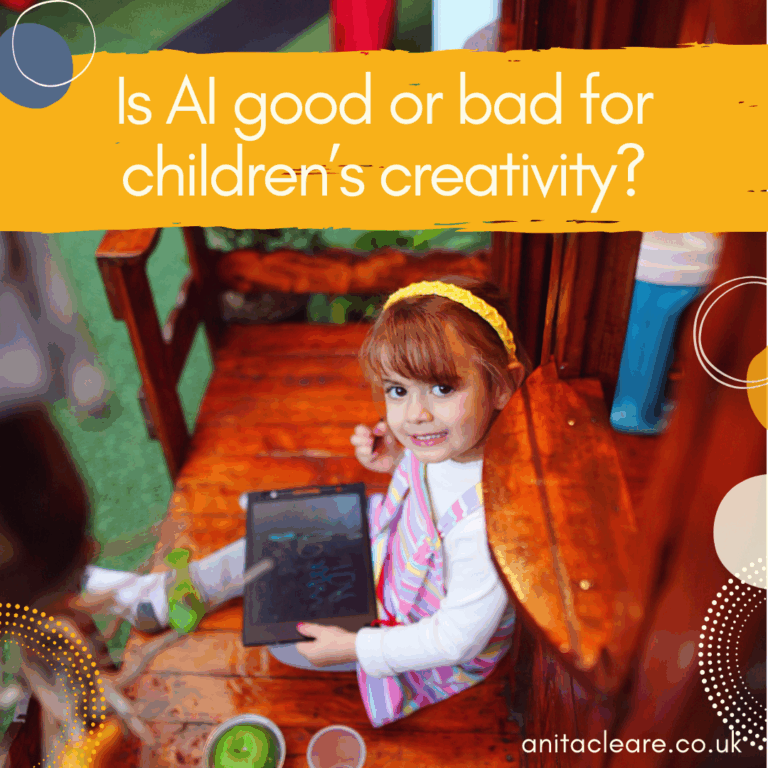
Think about a child drawing or painting a picture. Children can create sophisticated visual images through AI that look absolutely amazing, whereas drawing a picture takes time and the product isn’t as good. But practising drawing doesn’t just teach children to draw, it builds other vital skills like hand-eye-coordination, self-evaluation, and perseverance. The pride children experience through the application of effort (regardless of final product) builds their self-esteem.
Real world physical sensory experiences play a hugely important role in young children’s development. Imaginative free play is crucial for developing younger children’s social skills as well as their ideas generation.
And for that kind of quality play to happen, we need to turn off tech and allow young children to use creativity to overcome their boredom (see Why Boredom Is Good For Children).
If you want to encourage your child’s creativity, I’m not saying don’t let them use AI tools at all. But don’t let the tech squeeze out the real-world experiences that we know definitely do build children’s creative skills.
If you want your child to develop a creative mindset (and in a way that brings additional benefits for their overall development), their play diet should include:
Construction toys
These help children create spatially in 3D whilst learning about key physical concepts (like gravity) and exploring the sweet spot between form and function.
Perspective taking toys
Toys that can be voiced as characters in a story (such as dolls, teddies and action figures) help children step into others’ minds and emotions while also developing their storytelling and characterisation.
Building/Design projects
Allowing children to decorate their bedrooms or upcycle a piece of furniture or build a tree house (or just a bird box!) is great for developing the problem-solving and planning skills needed for creativity as well as manual dexterity.
Arts & Crafts
Organised creative activities like crafts can support creativity but only if we allow children freedom to be creative and don’t focus too much on producing neat or pretty products or on colouring between the lines.
Family challenges
A little bit of friendly competition can support lateral thinking skills. How about a family challenge to see who can design the best board game or who can come up with the 10 most interesting things to do with a sock! (See 20 Low Tech Family Time Ideas)
Conversation
Creative thinking doesn’t involve any materials. Rather than reaching for a phone in bored moments, how about a creative conversation? “If” questions are great for encouraging creativity: If you could open your own shop, what would it sell and what would you call it? If shoes could talk, what would yours say?
Use AI jointly with your kids
The best way to build AI literacy and introduce AI tools safely is to use them jointly with your children. Do this playfully and build on your child’s creative interests. Joint use of AI acts as a springboard for helpful discussions. And when we use AI tools together with our children, we also get the benefits of connecting over a shared activity and all the developmental richness of in-person relationships.
Exactly what the future holds for creativity in the age of AI is yet to be seen but if you can aim towards supporting children’s creativity in the widest sense – by focusing on the creative process and children’s wider development rather than just creative outputs – you will be setting them up to adapt and succeed no matter what the future holds.
Interested in this topic? You’ll love my keynote talk on ‘How to raise future-ready kids in the age of AI’.

Leave a Reply