
How do I know if I am over-parenting?
Deciding whether something counts as over-parenting is a judgement call. What you call over-parenting, another parent might regard as normal. Different children have different needs and abilities and require different types of support.
And, of course, there are some situations where we might consciously decide to do something for our children (that they could do themselves) just to show them that we love them.
However, we are definitely living in an era of intensive and competitive parenting and the data clearly shows a trend towards parents doing more and more for our kids.
Over-parenting can relate to something practical, like loading the dishwasher, or it might be emotional, like trying to protect children from experiencing failure.
We over-parent for the best reasons – because we love our children, we want to keep them safe, and watching them struggle is hard. Sometimes we over-parent from fear of being judged or from guilt – because we want to feel like a good parent. Or just out of habit, because it’s quicker or easier to load that dishwasher ourselves!
So, how do you know if you are over-parenting? These 4 questions might help you decide that.
1.What are the expectations at Nursery/school/elsewhere?
What does your child do in other settings? For example, if at nursery they are expected to clear the table after lunch and stack their plates and cutlery, but they don’t do it at home, you may be under-expecting.
2.Do I step in and rescue them when they might fail?
Do you allow your child to experience failure in order to learn? Or do you rush in to prevent them from making mistakes or rescue them when they make them?
3.Do I always give suggestions?
If you always make lots of suggestions or try to give solutions to your child for fixing their problems – rather than prompting them to find their own solutions – you may be over-parenting.
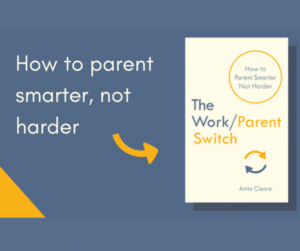
The example I give in my book The Work/Parent Switch is a child who keeps forgetting to take their packed lunch to school and as parents we ask ourselves the question ‘What can I do to make sure you don’t forget your lunch again?’ rather than asking our child ‘What can you do to make sure you don’t forget your lunch again?’
4.What were you doing at the same age?
This is a difficult one because all children are different and they don’t all develop at the same speed. And the world has changed a lot in the last few decades. There is more traffic, for example, so it might not be appropriate for your child to play out on your street unsupervised even though you did that. But it is still a really good sense checker and reminder of what children actually are capable of.
If al this sounds familiar, you might want to take a look at these ideas:
- The principle of minimal assistance
- Teaching children problem-solving skills
- Helping children earn to fail positively
- 6 Reasons your children should do chores

*This post contains affiliate links. That means that if you click through from this post and make a purchase, the Positive Parenting Project will receive a small commission. There is no additional charge to you. This helps us to keep providing free content for our readers. For more info, see Disclosure Notice.






Really insightful article! I especially liked the point about giving children opportunities to solve problems and learn from mistakes instead of always stepping in to help. Encouraging independence through everyday experiences and active play can help children build confidence and decision-making skills. Parents can also support this by giving kids opportunities to explore and play independently in a safe environment.