
How parents can build children’s Maths confidence
This is a guest post from Battersea House.
For many parents, Maths is one of the hardest subjects to support at home.
Not because parents do not care. Often, it is the opposite. Parents care so much that a short homework task can quickly become tense.
A child says, “I don’t get it.” The parent tries to explain. The child gets frustrated. The parent tries a different method. The child says, “That’s not how my teacher does it.” Before long, everyone is tired and the Maths has become bigger than the question on the page.
If that sounds familiar, you are not alone.
Maths confidence is not built by pressure, speed or getting everything right the first time. It grows when children feel safe enough to try, to make mistakes, ask questions and notice progress.
For busy parents, the aim does not need to be “teach the whole topic at home”. A more useful goal is to create small, calm moments where Maths feels manageable rather than threatening.
Why Maths confidence can be so fragile
Maths has a way of making children feel exposed. In some subjects, pupils can talk around an idea or have a go at an open-ended answer. In Maths, the answer can feel very final: right or wrong.
That can be hard for children who worry about making mistakes. It can also be hard for children who usually do well in other areas. A confident reader or strong writer may suddenly feel embarrassed when they cannot see the next step in a calculation.
Parents can unintentionally add to this pressure. Phrases like “This is easy” or “You did this last week” are usually meant to reassure, but they can make a child feel worse. If it is easy, why can’t they do it? If they did it last week, why can’t they remember?
A calmer message is “This is a skill. Skills take practice.”
That small change matters. It moves the conversation away from ability and towards learning.
Start with the emotion, not the method
When a child is upset about Maths, it is tempting to go straight into explaining the method. But if they are already frustrated, embarrassed or anxious, they may not be ready to listen.
Before helping with the question, it can be more effective to lower the emotional temperature.
“I can see this feels frustrating.”
“Let’s just find the first step.”
“You do not have to know it instantly.”
“We can work it out slowly.”
These phrases sound simple, but they help children feel less judged. Once the pressure drops, thinking usually improves.
This is especially important after school, when children may already be tired. A child who cannot manage a Maths task at 5pm is not lazy or incapable. They may be hungry, overstimulated or worn out from holding everything together all day.
Sometimes the best first step is not more explanation. It is a snack, a break or ten minutes away from the page.
Make Maths smaller
Children often lose confidence when Maths feels too big.
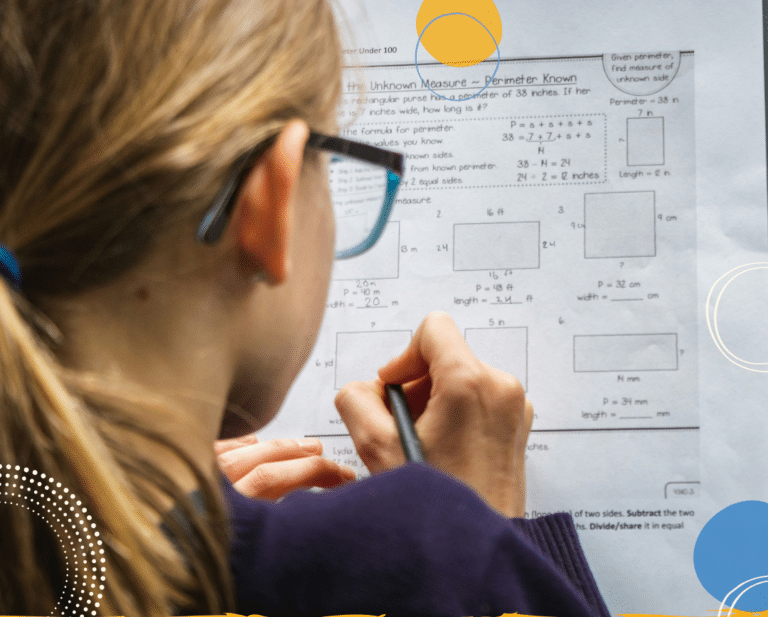
“Do your Maths homework” can sound overwhelming. “Let’s do the first three questions and then pause” feels more possible.
If your child is stuck, break the task down. Cover part of the page. Read one question aloud. Ask them to identify only what the question is asking. Then ask what information they already have.
The aim is to help them begin.
Starting is often the hardest part, especially for children who fear getting it wrong. Once they have made one small move, the task usually feels less impossible.
You can also separate the thinking from the writing. Some children freeze when asked to write the answer straight away. Talking through the problem first can help.
“What do you notice?”
“What have we been given?”
“What might the first step be?”
“Does this remind you of another question?”
These questions are better than simply asking, “What’s the answer?” They show your child that Maths is a process, not a performance.
Avoid turning speed into confidence
Fast Maths is not always confident Maths.
Some children are quick because they understand. Others rush because they want the task to be over. Some slower children are actually thinking carefully, but they begin to believe they are “bad at Maths” because they are not the fastest.
At home, try not to make speed the main measure of success. Timed practice can be useful in specific situations, but it can also increase anxiety if a child is already unsure.
Instead, you can praise clear thinking.
“I like how you checked that.”
“You noticed the pattern.”
“You spotted the mistake yourself.”
“You kept going even when it was tricky.”
These comments help children connect confidence with effort, strategy and persistence rather than speed alone.
Use real-life Maths gently
Maths confidence improves when children see that Maths is not only something that happens on worksheets.
This does not mean turning every family moment into a lesson. Most children can spot a forced “learning opportunity” from a mile away. But light, natural Maths conversations can help.
You might ask your child to help compare prices in a shop, halve a recipe, estimate how long a journey will take, work out pocket money savings, measure furniture or read a timetable.
The tone matters. It should feel like involvement, not a test. Instead of “What is 20% off this?” try, “I’m trying to work out if this is actually a good deal.” Instead of “Calculate the journey time,” try, “If we leave at 8:15, do you think we’ll get there before 9?”
These small moments help children see Maths as useful and ordinary. They also give them practice without the pressure of a red pen.
Be careful with your own Maths story
Many adults carry their own Maths memories. Some parents feel anxious around numbers because they were made to feel slow, silly or “not a Maths person” at school. It is completely understandable. But children pick up on the stories adults tell.
Saying “I was terrible at Maths too” may feel comforting, but it can also suggest that Maths confidence is fixed and inherited.
Instead, say “I used to find Maths stressful, so I know how that feels. Let’s take it slowly.” That acknowledges the emotion without passing on the idea that Maths ability is set in stone.
National Numeracy has highlighted how parents’ own feelings about Maths can affect children’s number confidence. The good news is that parents do not need to be Maths experts to help. A calm attitude, curiosity and willingness to think things through together can make a real difference.
Know when to step back
There is a point where helping stops being helpful. If a Maths task has become a battle, it is usually better to pause than to push through. Children rarely learn well when they are overwhelmed, and parents rarely explain well when they are frustrated.
You might say:
“This is getting stressful. Let’s stop for now and come back to it later.”
“We have found the difficult part, which is useful. We do not have to fix it all tonight.”
“Let’s ask your teacher which method they want you to use.”
Stepping back does not mean giving up. It means protecting the relationship and returning when everyone is calmer.
If the same issue keeps appearing, that is useful information. It may show a gap in understanding, a confidence issue or a mismatch between how the topic was taught and how your child is trying to remember it.

When extra support can help
Some children need more than encouragement. They may have missed key foundations, become anxious after repeated difficulty or lost trust in their own ability.
In those cases, one-to-one support can help because it gives the child space to ask questions without feeling watched by a whole class. A tutor can slow the topic down, find the missing step and help the child practise without the emotional charge that sometimes comes with parent-child homework.
For example, a child may not truly understand fractions, but the struggle only appears later when percentages, ratio or algebra begin to depend on that knowledge. Another child may know the method in class but panic when faced with a slightly different question. Confidence improves when those gaps are found and addressed calmly.
At Battersea House, our online maths tutors support pupils with subject knowledge, problem-solving, exam preparation and confidence. Families can also find a tutor for one-to-one support across primary, GCSE and A-level subjects.
 Battersea House is a UK online tutoring platform offering one-to-one support for students from primary school through to GCSE and A-Level. With a free first lesson and tutors across all subjects, Battersea House helps students build confidence, strengthen subject knowledge and feel better prepared for school.
This post contains affiliate links to Amazon which means that if you click through from this post and buy a book, the Positive Parenting Project will receive a small commission. There is no additional charge to you. This helps us keep providing free content. For more info, see Disclosure Notice.



Leave a Reply