
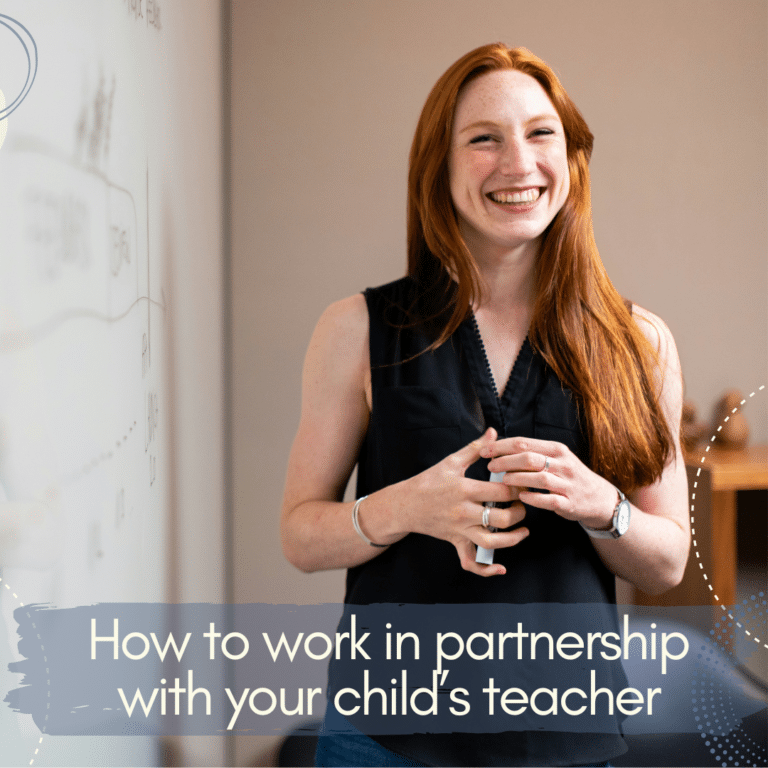
How to work in partnership with your child’s teacher
Guest post by Ben Whitaker and Steve Hope, authors of Pick ‘n’ Mix Education (Crown House Publishing)*
Between the two of us, we have spent decades in and around schools, as teachers, as SLT, as coaches, as consultants, and as dads. And one thing we hear constantly, from both sides of the classroom door, is that parents and teachers often feel like they’re operating in parallel rather than in partnership.
It’s not anyone’s fault. Teachers are stretched, and the opportunities for meaningful conversation beyond a ten-minute slot at parents’ evening are genuinely limited. (Ben’s experience was actually 4 minutes online where it cut off mid-sentence from the teacher!). Parents are busy, and the school gate can feel like a world that doesn’t quite speak their language. The result is that one of the most powerful forces in a child’s education – the combination of what a teacher knows and what a parent knows – often goes untapped.
Research consistently shows that when parents and teachers work together, children thrive: not just academically, but in terms of confidence, motivation, and wellbeing. The good news is that building this kind of partnership doesn’t have to be time-consuming. It just has to be intentional.
Here are six practical ways you can work in partnership with your child’s teacher.
Start the year with a brief introduction
Teachers learn a lot about children quickly, but there are things only you can let them know. For example, how your child responds to criticism. What makes them shut down? What they’re quietly brilliant at that nobody in school has noticed yet.
A short, friendly email at the start of the year – two or three sentences, no more – does more than you might think. Something like: “I just wanted to share a couple of things about Ella that might be useful as you get to know her.” Teachers rarely receive this kind of thing, which means when they do, it’s remembered. You’re not telling them how to do their job. You’re giving them information that helps them do it better – for your child.
Come to parents’ evening curious, not just concerned
Parents’ evenings can feel high-stakes, especially if you’re coming straight from work and have twenty minutes before you need to be somewhere else. Be aware that the parents who get the most from these evenings are the ones who arrive with questions, not just worries.
Try asking: “What does she find most engaging at the moment?” Or: “Is there anything about him that’s surprised you?” Or simply: “What’s the one thing we could do at home that would make the biggest difference right now?” These questions pave the way for a different kind of conversation – one where the teacher is sharing their full picture of your child, not just delivering a report. And they signal something important: that you’re on the same side.
Bridge the gap between home and school
Children are remarkably good at being different people in different places. The child who is quiet and cautious at school may be the one running the show at home. The one who seems disengaged in class may spend every evening absorbed in something that nobody at school knows about.
 You are the bridge between those two worlds, and that’s genuinely valuable. When you know what the teacher is working on with your child – a particular skill, a confidence goal, a new concept – you can quietly reinforce it at home. You don’t have to turn every car journey into a lesson; just when your child demonstrates it and say so. That kind of joined-up attention, even in small doses, builds momentum.
Ask the teacher once or twice a term: “What are you focused on with them right now?” Then keep it in mind.
Share the wins from outside school
One of the central ideas in our book, Pick ‘n’ Mix Education, is that children’s learning doesn’t only happen in classrooms – and one of the best things a parent can do is make sure the people who teach their child know what’s happening in the rest of their life.
Did your son spend the whole weekend building something intricate out of cardboard? Did your daughter just read her first full chapter book by choice? Did they do something socially brave that you didn’t expect? Tell the teacher. It takes thirty seconds, and it gives them a richer, fuller picture of the child in front of them. Teachers genuinely want to know. The bits of a child that come alive outside school are often exactly the levers that unlock something inside it.

Raise concerns early, and directly
Every parent has moments when something feels off – a child who’s dreading a particular lesson, a social situation that seems to be causing stress, a piece of feedback that felt unfair. The temptation is either to wait and see or to stew on it until it becomes a much bigger deal than it might need to be.
The most effective approach is simple: go to the teacher first, go early, and go with what you’ve observed rather than a conclusion already formed. For example, “I’ve noticed she’s been anxious about Wednesdays – I wondered if you’d noticed anything?” is a very different conversation from one that starts with an accusation. Early, calm, and direct almost always achieves a better result – and it preserves the relationship that your child benefits from every day.
Remember that you are part of the team
We wrote Pick ‘n’ Mix Education because we believe that the best education a child can have isn’t delivered from a single source; it’s curated, over time, from many, in a ‘village’. Great teachers are one of the most important ingredients in that mix. But so are parents who are paying attention, asking questions, and bringing what only they can bring.
You don’t need to be an expert in curriculum or pedagogy. You don’t need to volunteer at every school event or respond to every email within the hour. What children need is for the adults in their lives to be talking to each other – sharing what they see, working towards the same thing, and making sure that no important piece of the picture falls through the gap between home and school.
That’s not complicated. But it makes an enormous difference.
 Ben Whitaker and Steve Hope
 are co-founders of Edufuturists and authors of Pick ‘n’ Mix Education (Crown House Publishing), a practical guide for parents who want to take a more active role in shaping their child’s learning.
*This post contains affiliate links which means that if you click through from this post and buy a book, the Positive Parenting Project will receive a small commission. There is no additional charge to you. This helps fund the free information we provide to parents. For more info, see Disclosure Notice.


Leave a Reply